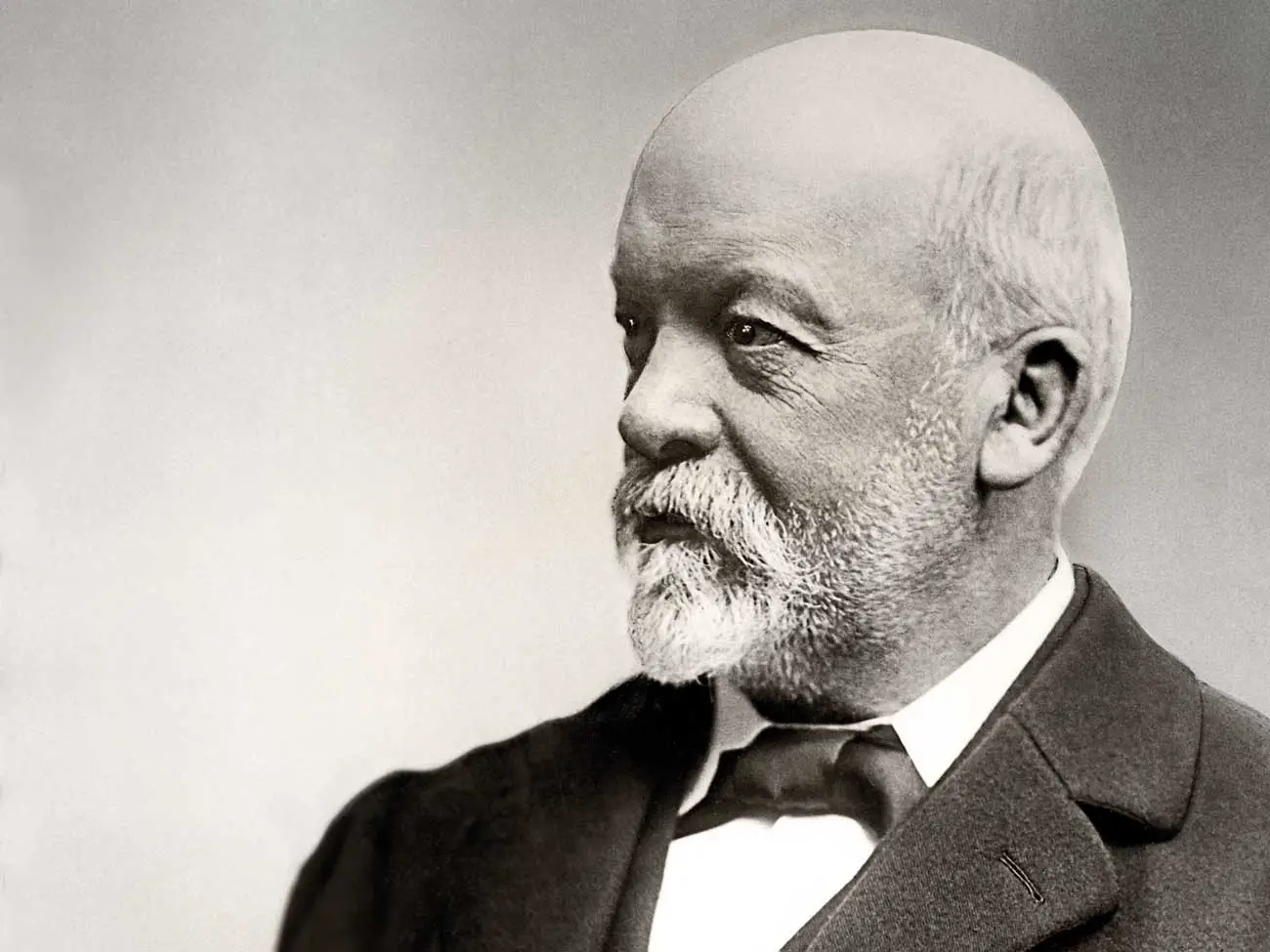
130 Years of the Truck – 1896, Gottlieb Daimler invented the world’s first truck. Like Gottfried Schenker, he was posthumously inducted into the Logistics Hall of Fame for his pioneering achievement. What may have seemed like little more than a technical curiosity in 1896 went on to become one of the foundations of modern global trade. Today, Daimler Truck is once again at a turning point in the history of transportation with its battery-electric eActros 600.
(featured photo: Daimler Truck / HJS archive)
When Gottlieb Daimler delivered the world’s first motorised truck on 1 October 1896, few could have imagined the impact his invention would have on business, trade and society. What began as a vehicle still bearing a strong resemblance to a horseless carriage went on to become the backbone of modern logistics. Today, millions of trucks travel the world’s roads and motorways, supplying cities, businesses and consumers with virtually everything needed for everyday life.
More Than an Automotive Pioneer
Born in Schorndorf in 1834, Daimler ranks among the most important technological pioneers of the Industrial Revolution. Together with his long-standing associate Wilhelm Maybach, he developed powerful internal combustion engines and played a decisive role in advancing the motorisation of vehicles. Daimler experimented with motorboats, airships and a wide range of applications for the internal combustion engine.
Today, he would probably be described as a visionary or tech entrepreneur. His significance for mobility can certainly be compared with the impact Steve Jobs had on digitalisation or Bill Gates on the widespread adoption of the personal computer. Yet one invention changed the world more profoundly and enduringly than any other: the truck.
130 Years of the Truck – A Revolution in Freight Transport
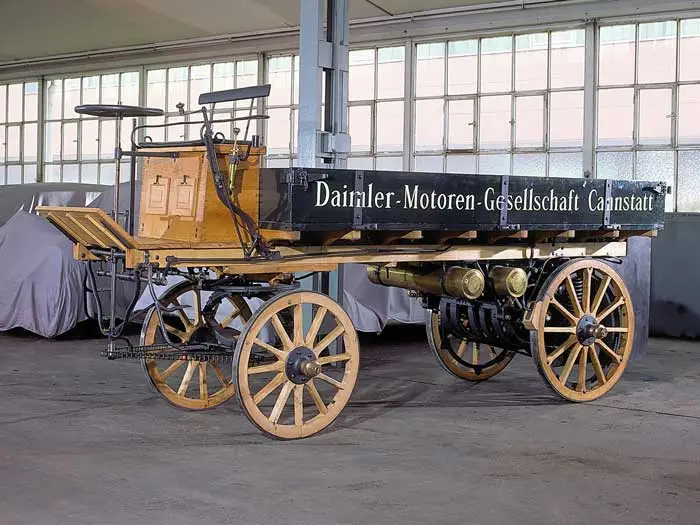
(Photo: Daimler Truck / HJS archive)
At the end of the 19th century, goods were still transported primarily by horse-drawn vehicles. Daimler realised early on that the internal combustion engine could power more than just passenger cars. His “Daimler Motor-Lastwagen”, unveiled in 1896, featured a two-cylinder engine producing four horsepower, carried a payload of around 1.5 tonnes and reached speeds of up to 16 kilometres per hour.
By today’s standards, those figures may appear modest. At the time, however, the vehicle was revolutionary. This new form of transport promised greater range, higher availability and significantly greater productivity than any horse-drawn vehicle of its day.
Remarkably, the first customer came from Britain. Daimler-Motoren-Gesellschaft sold the truck to the British Motor Syndicate in London. That very first delivery demonstrated that the significance of the innovation would extend far beyond Germany.
The Engine of Global Trade
The true significance of Daimler’s invention only became apparent over the decades that followed. The truck closed a crucial gap between ships, railways and the final recipient. Where goods had previously required cumbersome transshipment, they could now be transported directly from manufacturer to customer.
For the first time, this made seamless transport chains possible. Companies could tap into new markets, choose production locations more freely and supply customers economically over greater distances.
During the 20th century, the truck evolved into an indispensable link in an increasingly specialised global economy. Even today, no container arriving from Asia, no industrial product and no e-commerce parcel can complete its journey without road transport. Modern logistics networks, just-in-time production, global supply chains and the booming e-commerce sector ultimately depend on the concept Daimler first put on the road 130 years ago.
The truck therefore transformed much more than freight transport. It made global trade more flexible, faster and less dependent on railway infrastructure. Many economic historians consequently regard the truck as being as important to freight transport as the automobile has been to individual mobility.
Honouring a Logistics Pioneer
In recognition of this achievement, Gottlieb Daimler was posthumously inducted into the Logistics Hall of Fame in 2014. The international jury honoured him as the “inventor of the truck and pioneer of modern road freight transport”.
The jury emphasised that Daimler’s innovation represented far more than a technological invention. The truck laid the foundations for modern logistics networks and enabled the movement of goods on a scale that had previously been unimaginable.
130 Years of the Truck – From the First Truck to the eActros 600
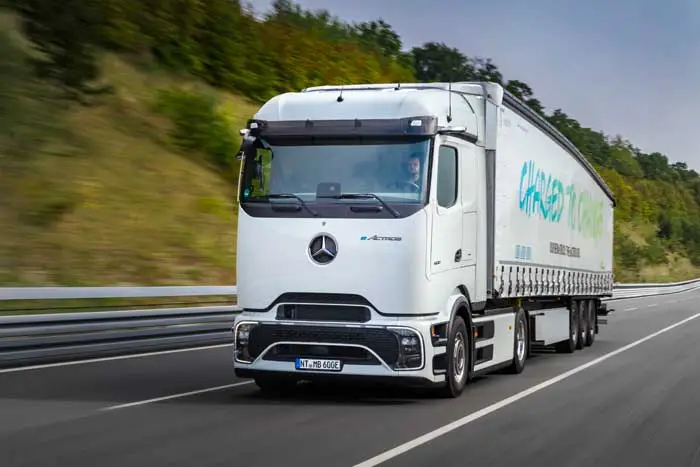
(Foto: Daimler Truck / HJS archive)
One hundred and thirty years after the birth of the truck, the industry is once again facing a fundamental transformation. Electric powertrains, hydrogen technologies, automated vehicles and digital transport platforms are shaping the future of freight transport.
Daimler Truck’s current flagship is the battery-electric Mercedes-Benz eActros 600. With a battery capacity of more than 600 kilowatt-hours, a range of around 500 kilometres without intermediate charging and the potential to cover more than 1,000 kilometres in daily operation, it is designed to help progressively decarbonise long-haul road transport.
The parallels with 1896 are striking. Back then, Daimler had to convince businesses to replace horse-drawn vehicles with motorised transport. Today, the industry faces the transition from diesel to electric powertrains. In both cases, the objectives remain much the same: greater efficiency, improved economic viability and technological progress. The fact that the eActros 600 has already been named “International Truck of the Year 2025” further underlines those ambitions.
Historical Parallels with Today
One hundred and thirty years of technological development separate Daimler’s first truck of 1896 from the eActros 600. In that sense, the truck itself can be seen as a symbol of technological progress. Yet throughout all this change, the fundamental idea has remained the same: to transport goods reliably, efficiently and economically from A to B.
Gottlieb Daimler therefore did far more than invent a vehicle. Through his innovations in the automotive field, he helped lay the foundations for an entire industry that remains a backbone of the global economy to this day. His ideas truly brought logistics into the motor age.
130 years of the truck: The eActros 600 shows that the same pioneering spirit continues to set the direction today. And so, for 130 years, the success story of the truck has quite literally kept the world moving.
eActros 600 – The New Flagship
The eActros 600 is Daimler Truck’s new flagship for electric long-haul transport. At its heart are three LFP battery packs with a combined capacity of 621 kWh, providing a maximum range of around 500 km. With up to 600 kW of peak power, a gross combination weight of up to 44 tonnes and MCS charging capability, the truck is designed to replace diesel-powered tractor-trailers on long-haul routes.
| eActros | Hard Facts |
| Battery capacity | 621 kWh gross, from three LFP battery packs of 207 kWh each |
| Usable energy | Around 600 kWh |
| Cell chemistry | Lithium iron phosphate (LFP), particularly durable and low in cobalt |
| Range | Up to 500 km without recharging in heavy-duty long-haul operation |
| Power output | 400 kW continuous output, up to 600 kW peak power (approx. 816 hp) |
| Axle concept | Electric drive axle with two integrated electric motors |
| Charging power | CCS fast charging at up to 400 kW; prepared for MCS at up to around 1 MW |
| Gross combination weight | Around 22 tonnes, almost on a par with diesel trucks |
| Payload | Up to 44 tonnes in Europe |
| Battery service life | Up to 1.2 million km or ten years, with more than 80% residual capacity |
Verwandte Themen
(Mehr zur HJS MEDIA WORLD finden Sie hier unter hjs-media-world.at)