
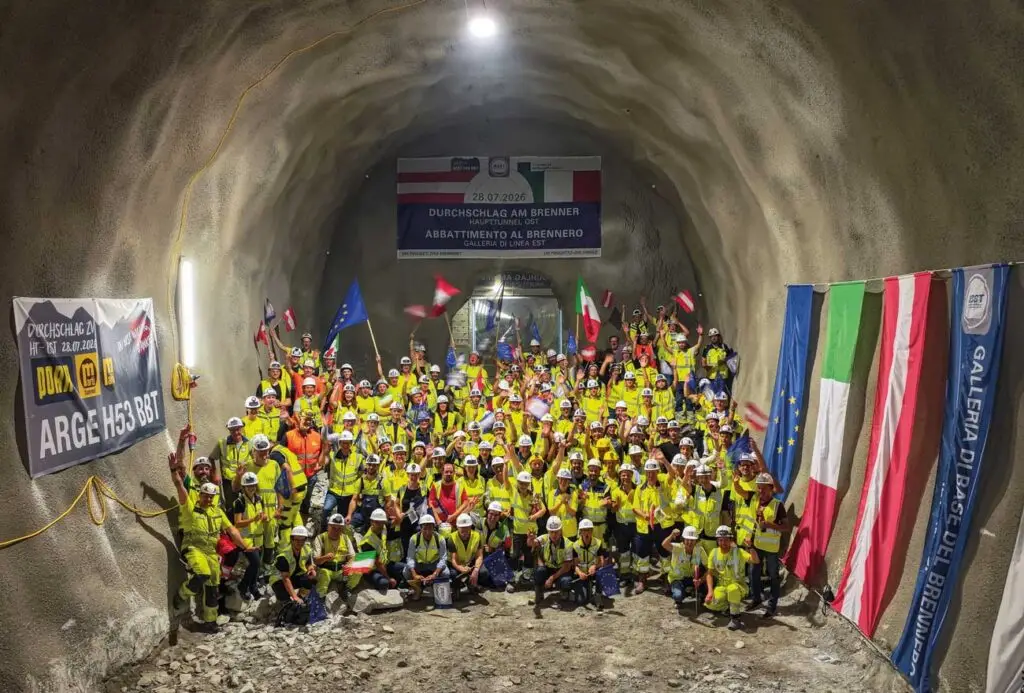
The Brenner Base Tunnel (BBT) will create a new rail link between Austria and Italy, carrying traffic in both directions. At the end of July, breakthroughs were achieved in both main tunnel tubes almost simultaneously. After around six years of demanding work, it was an emotional moment not only for the tunnelling crews.
(Photo: Theresa Theisl / Porr / HJS archive)
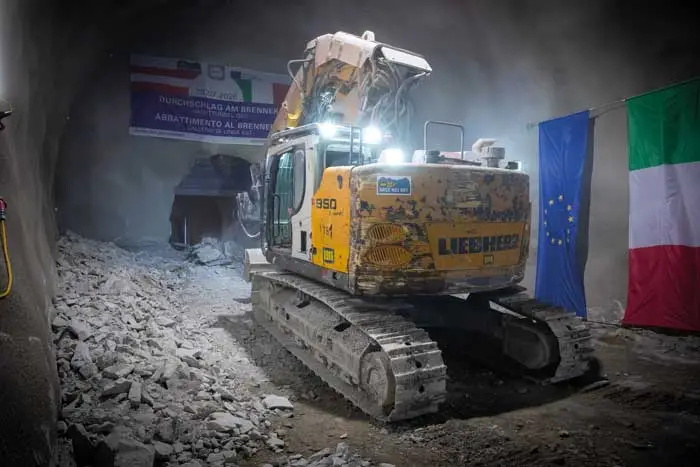
The BBT is considered the centrepiece of the European Scandinavian-Mediterranean Corridor (SCAN-MED), one of the continent’s most important north-south transport routes. According to PORR, the contract volume for the tunnelling works amounts to around EUR 959 million. With the near-simultaneous breakthroughs of the two main tunnel tubes at the Austrian-Italian border, the Brenner Base Tunnel reached one of its most important milestones at the end of July 2026.
Deep beneath the Geigenspitze mountain, around 1,400 metres below the surface, the tunnelling teams of the H53 joint venture formed by PORR and MARTI met their Italian counterparts. What was an emotional moment for the construction crews also sent a powerful signal to Europe’s transport and logistics industry: the largest infrastructure project in the Alpine region has taken a decisive step towards completion.
Hard Work Paves the Way for Success
The breakthrough took place in the two main tubes of the Pfons-Brenner construction lot, which were excavated from the Austrian side using conventional drill-and-blast tunnelling. The teams had to contend with extreme conditions. Rock temperatures of around 30 degrees Celsius, long material and transport routes, and the hard central gneiss placed enormous demands on both people and machinery. Nevertheless, the crews delivered an extraordinary feat of precision engineering: over more than five kilometres of tunnelling, the deviation from the planned tunnel axis was permitted to amount to only a few centimetres.
PORR CEO Karl-Heinz Strauss described the achievement as an exceptional team effort. Indeed, the successful cross-border breakthrough demonstrates the remarkable engineering expertise behind one of Europe’s most ambitious transport infrastructure projects. By the time of the breakthrough, around five kilometres of the eastern tube and 5.1 kilometres of the western tube had been excavated in construction lot H53 alone.
BBT: The Heart of the SCAN-MED Corridor
But the Brenner Base Tunnel is far more than a spectacular engineering project. It forms the centrepiece of the European Scandinavian-Mediterranean Corridor (SCAN-MED), one of the continent’s most important north-south transport arteries. Stretching from Finland through Central Europe to Malta, the corridor is regarded as a strategic lifeline for European freight transport. For decades, the Brenner route between Munich and Verona has represented a major bottleneck. The Base Tunnel is designed to eliminate this constraint.
The World’s Longest Underground Rail Link
(Photo: Wolfgang Gollmayer / PORR / HJS archive)
The actual tunnel between Innsbruck and Fortezza will be 55 kilometres long. Together with the existing Innsbruck bypass, it will form a 64-kilometre underground rail link, making it the longest of its kind in the world. At the same time, the steep and winding existing railway across the Brenner Pass will be replaced by an almost level, high-capacity rail connection.
BBT: Longer, Heavier Trains in Less Time
For the logistics industry, the implications are substantial. In future, significantly longer and heavier freight trains will be able to cross the Alps using just one locomotive. Journey times for freight trains through the tunnel are expected to fall to around 35 minutes, considerably strengthening rail’s competitiveness compared with road transport. The overarching objective is to shift a substantial share of freight traffic from road to rail, reducing congestion as well as noise and pollutant emissions along the Brenner corridor.
Commissioning Planned for 2032
The scale of the project is impressive. The entire tunnel system comprises around 230 kilometres of main, exploratory, rescue and access tunnels. According to the project company, well over 90 per cent of the excavation work has now been completed. The tunnel system is currently scheduled to enter service in 2032.
Olga and Wilma Keep Digging
The latest cross-border breakthrough does not, however, mark the end of the tunnelling work. The tunnel boring machines “Olga” and “Wilma” continue to drive the tubes towards Innsbruck. Even so, 28 July 2026 already stands as a historic date. It symbolises European cooperation, technological excellence and the vision of a more sustainable future for freight transport.
For Europe’s transport and logistics industry, the Brenner Base Tunnel could ultimately assume a role comparable to that already played by the Gotthard Base Tunnel: a key piece of infrastructure enabling efficient, competitive and climate-friendly freight transport across Europe.
Verwandte Themen
(Mehr zur HJS MEDIA WORLD finden Sie hier unter hjs-media-world.at)